



28 Mar Avoid the crisis with the Uncommon Service methodology.
Avoid the crisis by understanding what is essential for your business clients
Understanding your customer has always been important for a business to stay well and to avoid crisis.
In 2016, with the economy in recession and all the instability of the moment, this concept became essential for any company to keep breathing in the current scenario.
Because I work for a consulting company that integrates solutions corporate (ERP), I've noticed that even with the economic downturn, IT projects don't stop.
Despite leaner budgets, the clients continue to be in constant demand and, perhaps more than ever, demanding of the results obtained in order to avoid a crisis in their companies.
The big challenge is to carry out these projects with excellence in a not so good scenario. Finding the right balance between clients develop a good work to obtain new ones clients and using only the essentials in terms of costs/effort is the triad for staying profitable.
The problem is that difficult times we can only use what is essential:
1. Essential costs.
2. Essential hour/man
3. Essential stress attributes.
Being the manager of support-fix, an IT services area in the ERP segment, we are in contact with clients 10h/day, every day.
Understanding your needs is essential to keeping the wheel turning.
Some value speed in the resolution of IT calls, others value impeccable quality, and some value a personalized service for the company with each call.
They are clients demanding, who often require a variety of needs at the same time. Customers which generate complex demands that need maximum alignment between the teams involved.
“If I asked my buyers what they wanted, they would have said a faster horse. ”Henry Ford said that decades ago and it still makes perfect sense today. The problem is that if we don't ask in an objective way what the clients We don't want to sell cars or horses, because the customer will simply buy from another supplier who listens to them and understands them.
Understanding this need to fully listen/understand the customer, we sought a methodology that would fit into our service delivery process and help us with this objective.
And that's where Uncommon Service methodology.
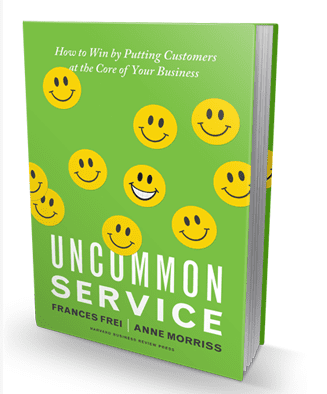
The methodology, presented in the book by Frances Frei and Anne Morriss, is based on understanding what is really essential for the customer and creating an excellent value offer on top of that.
The proposition is that to achieve this excellence it will be necessary to leave aside attributes and secondary actions that are not so important and generate extra costs in projects.
The objective is to disseminate the Uncommon Service as a management methodology in times of crisis. After all, it allows:
Deep understanding of clients and their needs. In order to differentiate between what they want and what they need.
Focus on developing a value proposition for this client, based on studies and dynamics.
Measuring attributes of my business that didn't mean much to my client and being able to eliminate them.
Reduce costs and redirect efforts.
All these items are useful in difficult times and to avoid the crisis. They help not only to reduce costs and better distribute our staff, but also to build loyalty. clients by simply listening to them and generating improvements for them.
Let's simplify in 6 easy steps how you can test the Uncommon Service methodology:
Simplifying Uncommon Service methodology - In 6 steps.
- The first step is to identify the attributes of your service. Examples: Speed in the delivery of proposals, quality in the resolution of demands, affordable costs, among others.
- At this stage, we need to reduce the attributes that do not demand efforts or relevant costs. For example: Visibility of the service (status, consultant, duration, etc.). This is an attribute that the vast majority of service providers offer and that all call systems have. It is an attribute that your service must have and at the same time does not demand any additional cost, after all, all systems on the market offer it.
- Having this list dry, you perform a dynamic within the company in order to order the attributes by degree of importance. At this point, you are having a vision of what you “think” is more or less important to the customer.
- This is the most important part of the whole process. Take the attributes from step 2 and conduct a survey of your clients. At this point, it's essential that you don't influence your customer in any way. For example: don't send an ordered list. Let them rank the attributes themselves. Take an average of the answers you get and you'll have an idea of what is really most or least important to them. At this point, you also ask your customer for an assessment of your performance and that of your competitor in each attribute.
- At the end of step 4, we will have the following visions: what does your company “he thinks” which is more or less important for your clients, which It is more or less important for their clients, a your performance on each attribute and the performance of the your competitor.
- With these results it is possible to set goals to improve the performance of the most important items for your customer. Always having the objective that its performance is greater than that of its competitors.
So I can't be good at everything?
You can find an example in the book called “Unreachable Triangle”. This triangle is the junction of QUALITY + SPEED + PRICE. It is called unattainable because it is impossible for a company to maintain the 3 high standards at the same time. If you can get quality and speed, your service is likely to be expensive. If you get price and speed, your service may lack quality. If you can get price and quality, it will take time to complete the service.
This example shows us that yes, you can try to be good at everything, but you shouldn't. Trying to have the best price, the best quality and the fastest delivery of service can drain your human resources, blow your budget or just go wrong at some point because it is extremely complex, and sometimes unnecessary.
In general terms Uncommon Service Methodology argues that companies should be “dare to be bad” in some respects, eliminating areas or activities where they are underperforming, while focusing on and leveraging others that can give you a winning competitive advantage.
In other words, companies should focus on the attributes that their customers really value. clients and not the ones they think are important to them. That's why the exercise is so important. You visualize where your customer sees an advantage and put that advantage together for them. This technique is also important for avoiding a crisis.
The Methodology includes various techniques and actions aimed at boosting the provision of services, whether or not added to the physical sale of products, based on analysis of the perception of the value attributes recognized by the people. clients, This includes comparative research into competitors and the development of specific optimization and change plans.
Luiz Fernando - Manager of support-fix
Sorry, the comment form is closed at this time.