



12 May Intelligent automation: what it is, benefits and implementation technologies
The volume of data handled in today's corporate operations often exceeds the human capacity for manual processing.
For years, teams such as finance, human resources and procurement have faced slow and failure-prone data entry routines.
Traditional automation tools helped to reduce repetitive effort at first, but they are already encountering structural limits as they stall in the face of variation in a non-standardized layout or document.
The market is therefore demanding a new approach to corporate efficiency, where technology understands and resolves exceptions without the need for constant human intervention. This is the context of intelligent automation.
Read on to find out more!
What is intelligent automation?
THE intelligent automation represents the natural technological evolution of operational and transactional systems. Its aim is to create systems that not only perform repetitive tasks, but that are capable of reading unstructured data, learning patterns and make decisions autonomously.
The systems no longer depend on fixed coordinates and start to interpret the context of the content.
For example, software locates and understands the CNPJ number regardless of its position in the document, adjusts the internal flow and completes the task.
This ability to adapt in real time guarantees the hyper-automation of areas, protecting the company against delays caused by variations within the process.
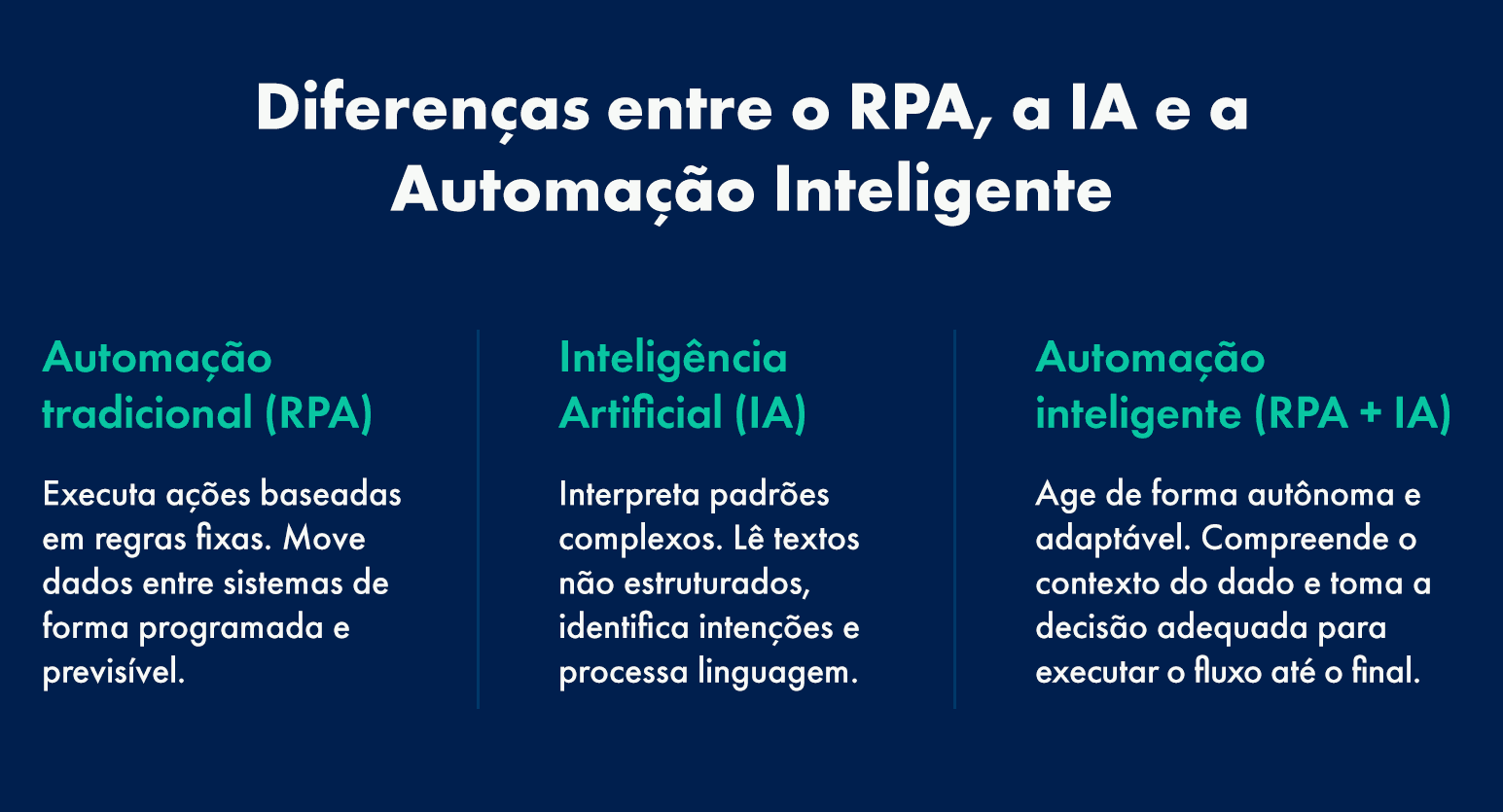
What is the difference between RPA, AI and intelligent automation?
Understanding the limitations and strengths of each tool makes it easier to choose the best architecture for the project.
What are the benefits of intelligent automation?
The adoption of this technology is aimed directly at solving the operational and financial pains that drain business resources.
Departments suffer daily from untold hours spent on exhaustive typing and manual verification of information (data entry), accompanied by the chronic slowness of legacy systems.
By implementing AI Agents that understand and manage the data themselves, The cycle time of processes is considerably reduced. The organization eliminates operational bottlenecks and directs its workforce towards strategic analyses.
In this way, technology acts as a protective barrier, mitigating the risk of human error in bureaucratic and tedious tasks.
It is important to note that the massive use of AI for productivity is not restricted to the mere speed of routines.
The gain is directly reflected in control, in robust governance, in the reduction of errors and a tangible ROI that sustains the viability of investments in technology.
What are some practical examples of intelligent automation?
Applying these technologies in an orchestrated way transforms the operational reality of different business verticals. By materializing the concept in real workflows, we see the direct impact on corporate agility:
Finance and Accounting
Invoice reconciliation becomes a continuous and autonomous process.
The system executes the document capture, validates the amounts against the purchase orders, verifies the authenticity on the municipal or state portals and schedules the payment on the ERP, and resolving cent disagreements without crashing the operation.
Human Resources
THE automation of the intake flow (onboarding) manages everything from the collection and validation of personal documents to the creation of system accesses.
The AI analyzes the proofs sent by the candidate, identifies pending issues and interacts automatically to request corrections, reducing the time it takes for the new employee to join.
Customer service
Sorting complex tickets is no longer a slow, manual task.
AI agents perform the initial reading of calls, They identify the level of urgency and the technical issue involved, directing the case immediately to the right specialist, accompanied by a summary of the facts.
DOC.IA - intelligent document automation
One of digital transformation is the extraction of data from documents with various layouts.
Invoices, contracts and invoices change format depending on the issuer, which often makes automations based on fixed rules unusable.
It is against this backdrop that DOC.IA, solution developed by MPL's innovation unit, acts as a watershed.
As a layout-agnostic “Document Agent”, DOC.IA uses the artificial intelligence to reading and understanding the contents of any file, regardless of where the information is positioned.
The great strategic differential lies in its Multi-LLM architecture, which selects the appropriate AI for the weight and complexity of each document processed.
Improve your processes with intelligence and governance
Intelligent automation is the technical answer to the data overload that often paralyzes the back office.
However, implementing this technology correctly requires more than choosing a tool; it requires a strategy that balances cognitive capacity, process governance and financial viability through FinOps practices.
By adopting solutions that operate with flexible architectures and intelligent agents, In this way, your organization eliminates manual errors and returns teams' time to activities that generate real strategic value.
The safe way forward combines technology with the experience of those who have mastered systemic integration.
Discover how MPL can accelerate your productivity with efficiency and cost control.
Frequently asked questions about intelligent automation
How does intelligent automation impact human work?
Technology acts directly to eliminate data entry and repetitive administrative tasks. By delegating bureaucracy to AI Agents, the company is able to reposition its professionals for strategic analysis, exception management and functions that require complex human judgment.
How to automate processes in companies?
Successful implementation first requires detailed mapping of business pains and technological literacy on the part of the leadership. Next, technologies with flexible architecture and financial governance models must be chosen, avoiding excessive cloud costs and ensuring that the solution integrates seamlessly into the existing IT ecosystem.
Sorry, the comment form is closed at this time.