



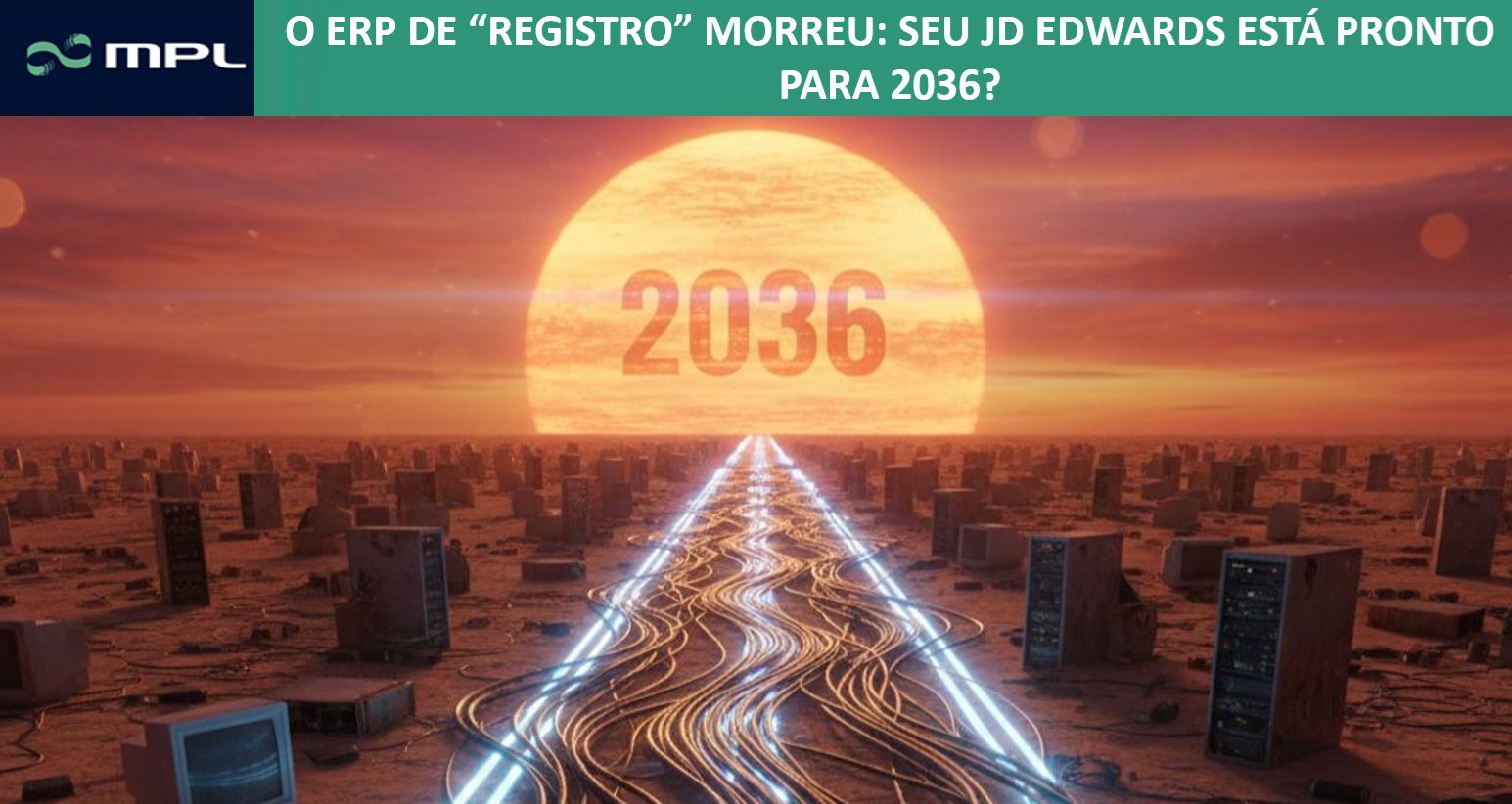
13 Feb The Future of JD Edwards to 2036: Are you just surviving or are you innovating?
Many leaders still look at the ERP as a rear-view mirror tool: a place where you record what has already happened to ensure compliance and accounting closures.
If you still see JD Edwards that way, you're missing the biggest window of opportunity of the last decade.
The new Roadmap released by Oracle is not just a list of technical updates. It is a statement of independence for business operations. We are entering the era of ERP Active, where the system not only stores data, but anticipates decisions through Artificial intelligence and Process Automation.
Oracle's recent Roadmap for JD Edwards brought news that should put many CIOs' minds at ease: premier support for version 9.2 has been extended until at least 2036.
This isn't just an extended deadline; it's an invitation to reinvention. With a window of more than 10 years of continuous innovation guaranteed, the question for companies is no longer “how long will the system last”, but “how smart can it be today”.
The “ERP 2005”
Many companies still operate JD Edwards as if it were 2005. They use classic menus, manual processes and see the system only as a data repository.
The market no longer forgives slow manual labor. JDE's new direction focuses on three pillars that transform efficiency into real profit and its new roadmap makes it clear that JDE's “Next Gen” focuses on transforming this scenario through three fundamental pillars:
- Artificial intelligence (AI Enablement): The system now uses AI to accelerate business results and redefine workflows. Since the use of OCI AI Vision from component inspection to invoice automation, AI is no longer theory but real productivity.
- Enterprise Automation: The evolution has gone from simple automation of tasks to automation of entire processes, allowing blind spots of inefficiency to be identified and acted upon in real time.
- Sustainability (ESG): The new Sustainability Framework makes it possible to collect and validate emissions data (Scopes 1, 2 and 3) directly in the ERP , ensuring that your company meets regulatory requirements with precision.
The Future is Clean Core“
The big turning point for 2026 is modernization without complexity. Through technologies Low Code and No Code, Oracle allows companies to adopt these innovations without hurting the core of the system, facilitating continuous updates and eliminating the fear of heavy customizations of the past.
The question for C-Levels and IT managers today is no longer “when” to modernize, but “how quickly” your company can absorb this intelligence so as not to be left behind.
Where the MPL enter this journey?
At MPL, we combine more than 40 years of tradition in technology and business innovation with solutions in Artificial intelligence, process automation and integration with ERPs such as JD Edwards. Our approach combines technical expertise with Low Code and No Code tools, enabling agile, scalable and accessible deployments for different company profiles. We work to accelerate the digital transformation, improve productivity and support data-driven decision making with security, efficiency and intelligence.
Oracle's roadmap to 2036 is the fertile soil. MPL's expertise is the tool that makes your company reap results now.
Is your company using JD Edwards 2005 or is it ready for 2036? Let's talk about your next modernization step.
#JDEdwards #Oracle #MPL #EnterpriseAutomation #AI #ESG #InovaçãoTecnológica #ERP2036
Sorry, the comment form is closed at this time.